Our pilot programs support new research on life course environmental exposures and Alzheimer’s disease and related dementias (AD/ADRD) risk and resilience.
The Gateway Exposome Coordinating Center (GECC) seeks pilot projects each year that advance research on the various environmental exposures over the life course — known as the “exposome” — that affect health outcomes, with a focus on Alzheimer’s Disease (AD) and AD-Related Dementias (ADRD) risk and resilience.
selected each year
per award, including indirect costs
2026–2027 project period
The application period for 2026–27 pilot projects is now closed.
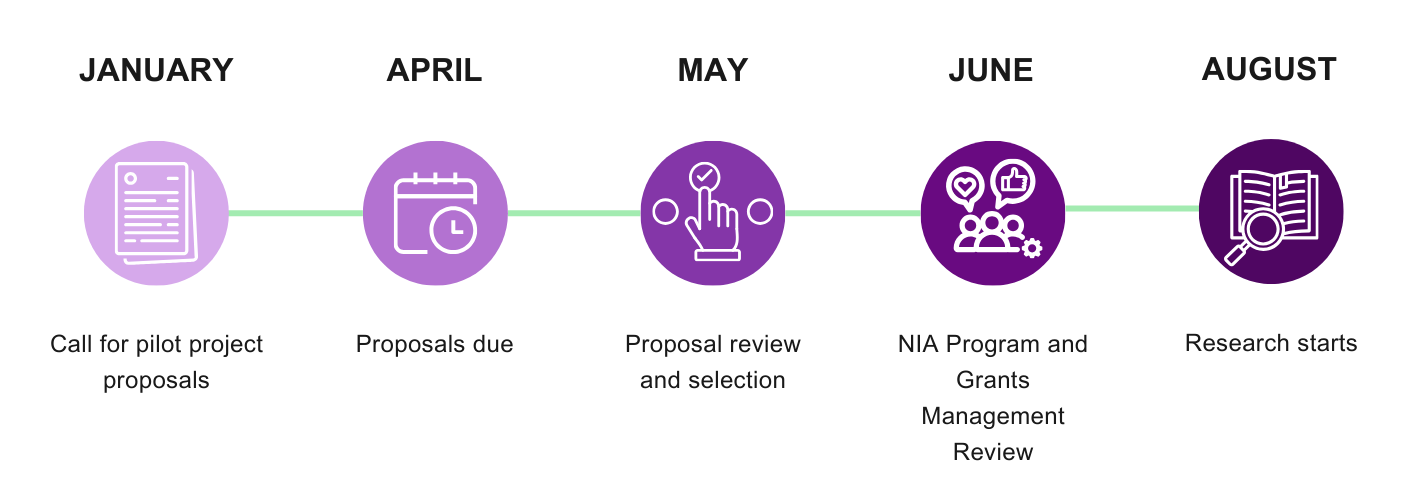
The call for 2027–28 pilot project proposals will be in early January 2027. Please sign up for the GECC mailing list to receive announcements (see bottom of page).
Pilot projects should support the GECC’s mission to provide consistent guidance and measures for open science research that advance understanding on links between life course exposures and health, with a focus on AD/ADRD risk and resilience. The most competitive pilot projects will create novel measures, data sets, or data guidance for exposome research.
Projects may be related to or build on one or more of the six GECC domains of study: extreme weather domain, physical environment, social environment, policy environment, community services environment, and life experiences. Pilots focused on methodological topics cutting across multiple substantive domains are encouraged.
Not sure whether your project is a good fit for the GECC? Please contact us at pilots@gatewayexposome.org.
We welcome pilot studies across disciplines and from researchers at any stage of their career and background, especially from investigators transitioning into AD/ADRD research, researchers from less traditional disciplines than those that normally engage in AD/ADRD research, and those working with underrepresented groups.
Proposals must be submitted by U.S.-based applicants. We welcome proposals from public and private non-profit organizations, institutions of higher education, hospitals, and non-profit research institutes.
Applications will be evaluated on the following criteria:
View the evaluation criteria used in the previous application cycle
Note: The application period for 2026–27 pilot projects is now closed. Please check back in January 2027 for more information regarding the next application cycle.
Applicants should submit all materials using this Google Form application. Submissions through the form require a Google account. If you have any issues, please contact us at pilots@gatewayexposome.org. To complete the application, please prepare:
Applicants were notified of funding decisions in May 2026. The 2026–27 pilot projects will be announced after GECC’s funding for 2026–2027 is awarded (expected August 2026).
For other questions about the application process, please email pilots@gatewayexposome.org.
Sign up for our mailing list below to get pilot funding announcements.
The Gateway Exposome Coordinating Center (GECC), the National Alzheimer’s Coordinating Center (NACC), and the AD Data Initiative invite Alzheimer’s Disease Research Centers (ADRCs) to apply for pilot funding to link ADRC participant data with an initial set of GECC exposome measures.
funded through this program
total costs each, including 10% indirect costs
project period
Proposals due February 19, 2027
Applicants will be notified of funding decisions by March 2027.
Upcoming listening session
November 19, 2026 · 12:00 pm PT / 3:00 pm ET
Join us for an interactive information session to learn more about the ADRC-Exposome pilot program and opportunities for ADRC participation. The session will offer an overview of the program, provide an opportunity to connect with GECC domain leads, and create space for questions, feedback, and discussion. Participants will also be invited to explore potential collaborations and learn how GECC can support the development of interdisciplinary pilot projects.
Each pilot project will complete the following stages:
Projects should advance the GECC’s mission by improving knowledge of AD/ADRD, generating better data and tools for future research, and producing scientifically valuable evidence. The pilot program will also promote collaborations between ADRC investigators and researchers across some of GECC’s six domains of study: Extreme Weather, Physical Environment, Social Environment, Policy Environment, Community Services, and Life Experiences. Pilots addressing methodological questions across multiple substantive domains are encouraged.
Not sure whether your project is a good fit for the GECC? Please contact us at pilots@gatewayexposome.org.
Applications must be submitted by a U.S.-based Alzheimer’s Disease Research Center. Investigators at any career stage may participate, and interdisciplinary teams are strongly encouraged. We support a team science approach and encourage ADRC investigators to team up with collaborators with expertise in exposome science relevant to the proposed study.
Applications will be evaluated on the following criteria:
Applicants should submit all materials using this Google Form application. To complete the application, please prepare:
Applicants will be notified of funding decisions by March 2027.
For questions about the application process, please email pilots@gatewayexposome.org.
The following exposome data are currently available or soon to be available. The Gateway to Global Aging Data, a parent infrastructure project for GECC, made several key exposome data available, which are already linked to several cohort studies. The Gateway Exposome Coordinating Center is building much richer exposome data, a subset of which are already available or soon to be available.
All data will be available through the following channels:
Code will be made available through the GECC GitHub.
Gateway Available through the Gateway to Global Aging Data. Exposome Data Descriptions are also available for these measures.
GECC Available through GECC
GECC - Coming soon Coming soon to the GECC
Guidance and Recommendations coming soon (Alzheimer’s & Dementia)
| Measure | Years | Temporal resolution | Spatial resolution |
|---|---|---|---|
| Population-weighted daily temperature GECC | 1970–2024 | Daily | Census tracts and ZCTAs |
| Population-weighted daily wet bulb globe temperature GECC | 1970–2024 | Daily | Census tracts and ZCTAs |
| Population-weighted daily Universal Thermal Climate Index (UTCI) GECC | 1970–2024 | Daily | Census tracts and ZCTAs |
| Natural disaster events GECC - Coming soon | 1960–2024 | Daily | County |
| Tropical cyclones GECC - Coming soon | 1970–2024 | Daily | Census tracts and ZCTAs |
| Floods GECC - Coming soon | 2000–2018 | Daily | Census tracts and ZCTAs |
| Temperature GatewayMinimum, maximum, mean, and extreme heat days at the 97.5th and 99th percentiles | 1982–2024 | Daily, annual, 10-year climate norm | 9 km |
| Heat index Gateway | 1982–2024 | Daily, annual | 9 km |
| Precipitation Gateway | 1982–2024 | Daily, annual, 10-year climate norm | 9 km |
Linkage code: Code to link spatiotemporal data and individual averages based on residential histories and observation dates at exact addresses for weather Gateway
Guidance and Recommendations (Alzheimer’s & Dementia)
| Measure | Years | Temporal resolution | Spatial resolution |
|---|---|---|---|
| Green space (Normalized Difference Vegetation Index, NDVI) GatewayData for 1984–1999 at 30 m resolution coming soon to the GECC | 2000–2025 | Annual | 250 m |
| Blue space Gateway | 2000–2012 | Average value, 2000–2012 | 150 m |
| Nighttime light Gateway | 2012–2025 | Annual | 0.0042° (~400 m) |
| Fine particulate matter (PM2.5) Gateway | 1998–2024 | Monthly | 1 km |
| Fine particulate matter (PM2.5) from different sources GatewaySources include agriculture, energy production, industry, commercial combustion, residential combustion, transportation, international shipping, wildfires, and windblown dust, derived from 2017 source fraction data and temporally varying total PM2.5 estimates | 1998–2024 | Monthly | 1 km |
| Nitrogen dioxide (NO2) Gateway | 2005–2020 | Annual | 50 m |
| Ozone (O3) Gateway | 1990–2017 | Annual | 0.1° (~11 km) |
Linkage code: Code to link spatiotemporal data and individual averages based on residential histories and observation dates, at exact addresses for air pollution and nighttime light, and within buffers (0, 250, 1,000, and 5,000 meters) around the home for green space and blue space
Coming soon to the GECC:
Gaps and Priorities (Alzheimer’s & Dementia)
| Measure | Years | Temporal resolution | Spatial resolution |
|---|---|---|---|
| Social connections GECC - Coming soonConcepts, Measures, and Priorities (Alzheimer’s & Dementia) | — | — | — |
| Third spaces GECC - Coming soonMeasuring “third places” (Alzheimer’s & Dementia) | 2000–2024 | — | Census tracts and ZCTAs |
Gaps and Priorities (Alzheimer’s & Dementia)
Proximity data: An original dataset of community care services, measuring availability and accessibility through travel time to the nearest facility and cumulative opportunity (e.g., number of hospitals within a specified travel time). Facility types include:
This work is supported by Gates Ventures

Sign up for our mailing list below to hear about future pilot opportunities.